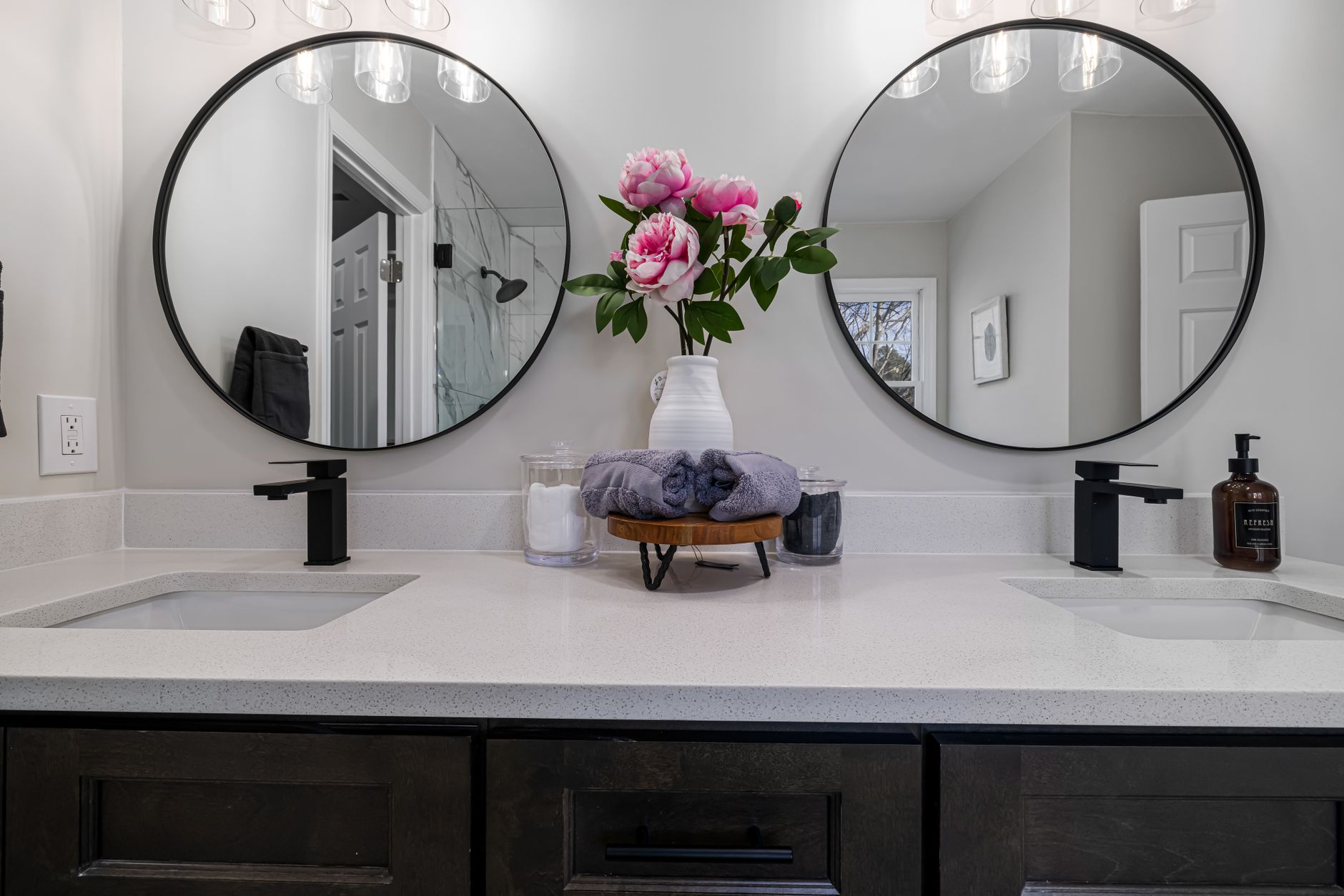
The right bathroom mirror is about as wide as the vanity or a few inches narrower, hung so the bottom edge clears the faucet by a few inches, with a frame that survives steam and glass that stays clear. Get size, height and frame right and the mirror becomes the anchor of the wall. This guide is about the mirror itself. For the light around it, see how to light a bathroom, the vanity lighting calculator and lighting for makeup and shaving.
| Question | Rule of thumb |
|---|---|
| How wide? | As wide as the vanity, or a few inches narrower |
| How high? | Bottom edge a few inches above the faucet and backsplash; center near eye level for the main user |
| Which shape? | Rectangles echo square vanities; round or oval softens hard lines |
| Which frame? | Metal, sealed wood or plastic in a damp room; raw wood is risky |
| Mirror or cabinet? | A mirrored medicine cabinet adds hidden storage |
| Foggy glass? | Run the fan first; heated pads or squeegees help |
Size: match the vanity
A mirror that is too small makes the vanity look underdressed, and one that is too large crowds the lights and the ceiling. Aim for the width of the vanity or a few inches narrower. For a double vanity, either two separate mirrors or one wide mirror works, but center each mirror over its own sink. If two people use the sink at once, a single mirror roughly 30 inches wide or more tends to give both room to see without bumping elbows.
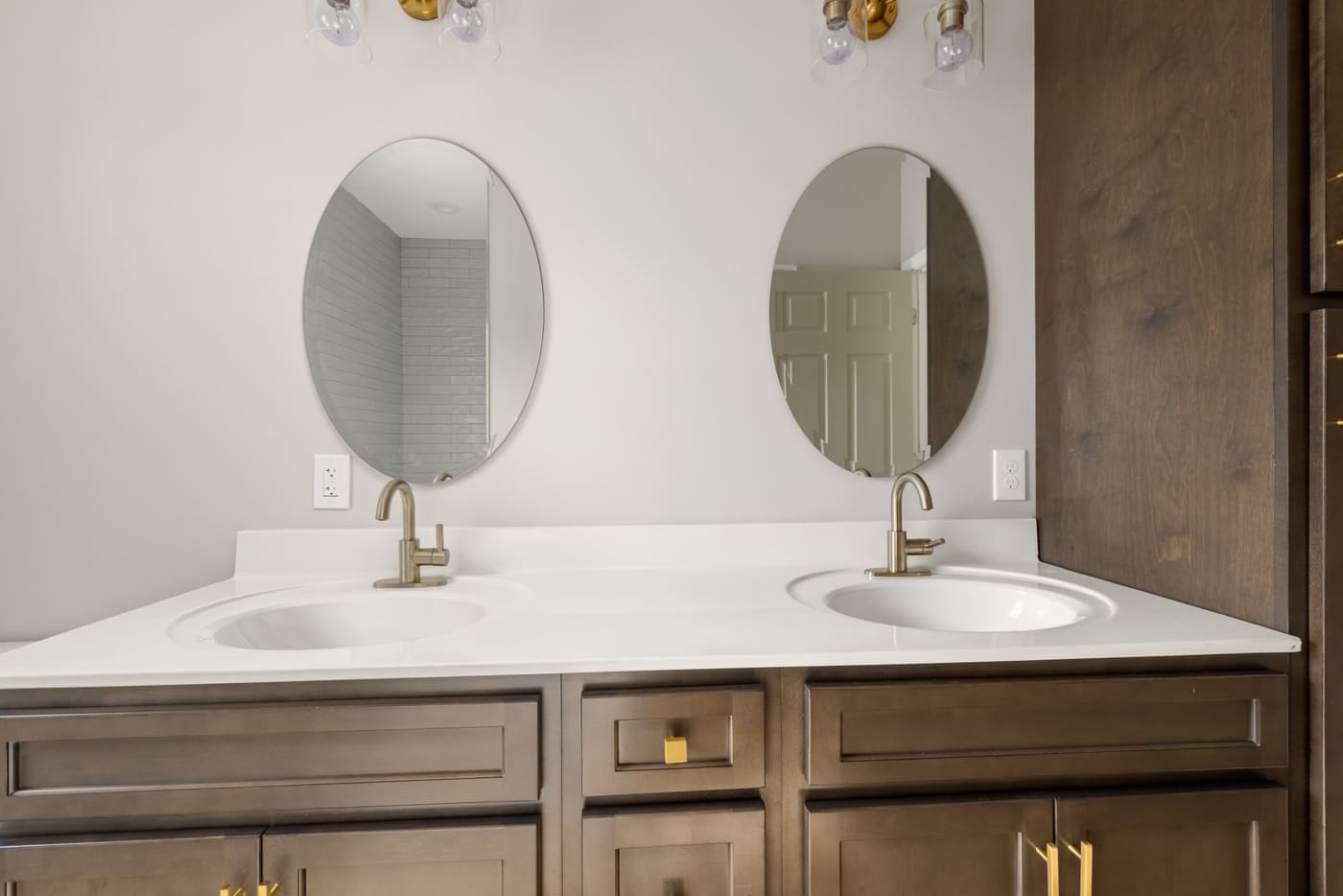
For a shared sink, one wide mirror reads as a single calm surface, while two small mirrors can look like two separate zones that each need styling.
Hanging height and center point
- Bottom edge: A few inches above the faucet and backsplash so water does not hit the frame and you can see yourself from the top of the head to the shoulders.
- Center: About eye level for the person who uses it most. If two people of very different heights share the sink, favor the shorter person and let the taller one tilt.
- Weight: A heavy mirror needs fasteners rated for its weight, in studs or proper anchors, never a single small nail. If you cannot tell what is behind the wall, ask a professional before drilling near a sink, since supply lines and wiring can run close to the vanity.
If an existing mirror is glued to the wall, removal can damage the drywall. That is a job for the landlord or a pro, and renters should leave it alone.
Shape: pick one that suits the room
Shape sets the mood of the whole wall. Match it to what is already there.
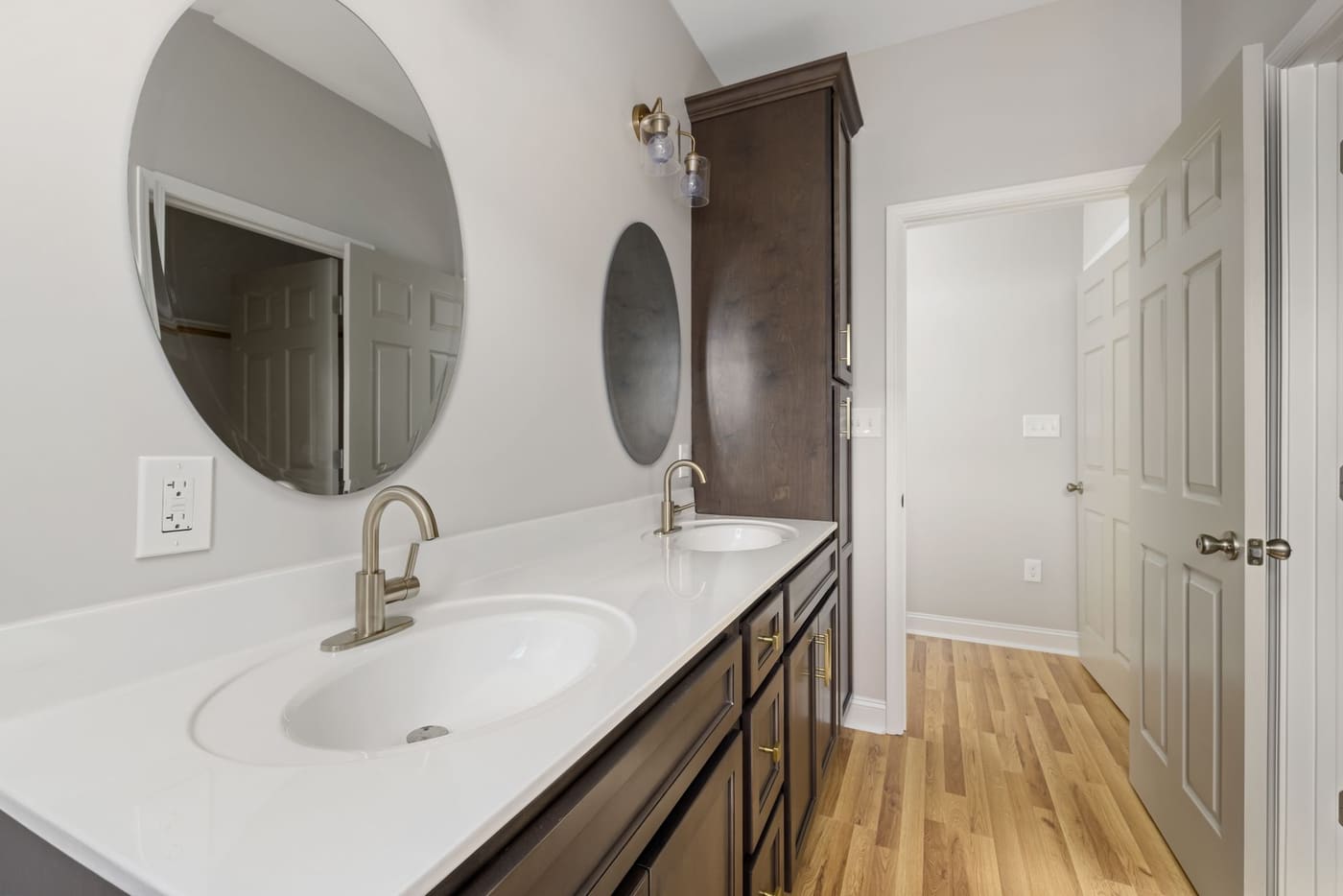
- Rectangle or square: Quiet and practical. Echoes a boxy vanity and straight tile lines.
- Round or oval: Softens a room full of right angles. Pick a diameter that is close to the vanity width, since a small round mirror looks lost above a wide sink.
- Arched or rounded-top: Adds a gentle focal point. Make sure the arch leaves enough glass at eye level.
- Tall and narrow: Suits a pedestal sink or a narrow wall. Check it covers the heights of everyone who uses it.
One mirror per sink, in one shape, looks calmer than a mix. Three tiny decorative mirrors read as a collection, so choose one larger piece instead.
Frame: what survives steam
In a damp room, metal, sealed wood or plastic frames hold up better than raw wood. Moisture creeping behind the glass edge can cause dark spots over time. A frame in the same finish as your faucet and hardware makes the wall look planned, and a thin frame suits a small room while a thick one suits a larger vanity. If you want the room to feel warmer, a wood or brass frame does that, and the warmer bathroom guide shows how it fits with other materials.
A frameless mirror with a polished edge is the simplest choice and works with almost any style. A builder-grade mirror glued flat to the wall can look more finished with a frame kit added, but check the manufacturer’s instructions and your lease before you attach anything.
Mirror or medicine cabinet
A recessed or surface-mounted medicine cabinet with a mirrored door keeps toothpaste, razors and medications out of sight, which does more for a tidy look than any decor. Measure the wall opening before buying a recessed unit, because it sits between studs and the rough opening is fixed. A surface-mounted unit is simpler when you are unsure what is behind the wall. Store medicines in line with their labels, and keep any medicine out of reach of children and pets, ideally in a locked box if children visit.
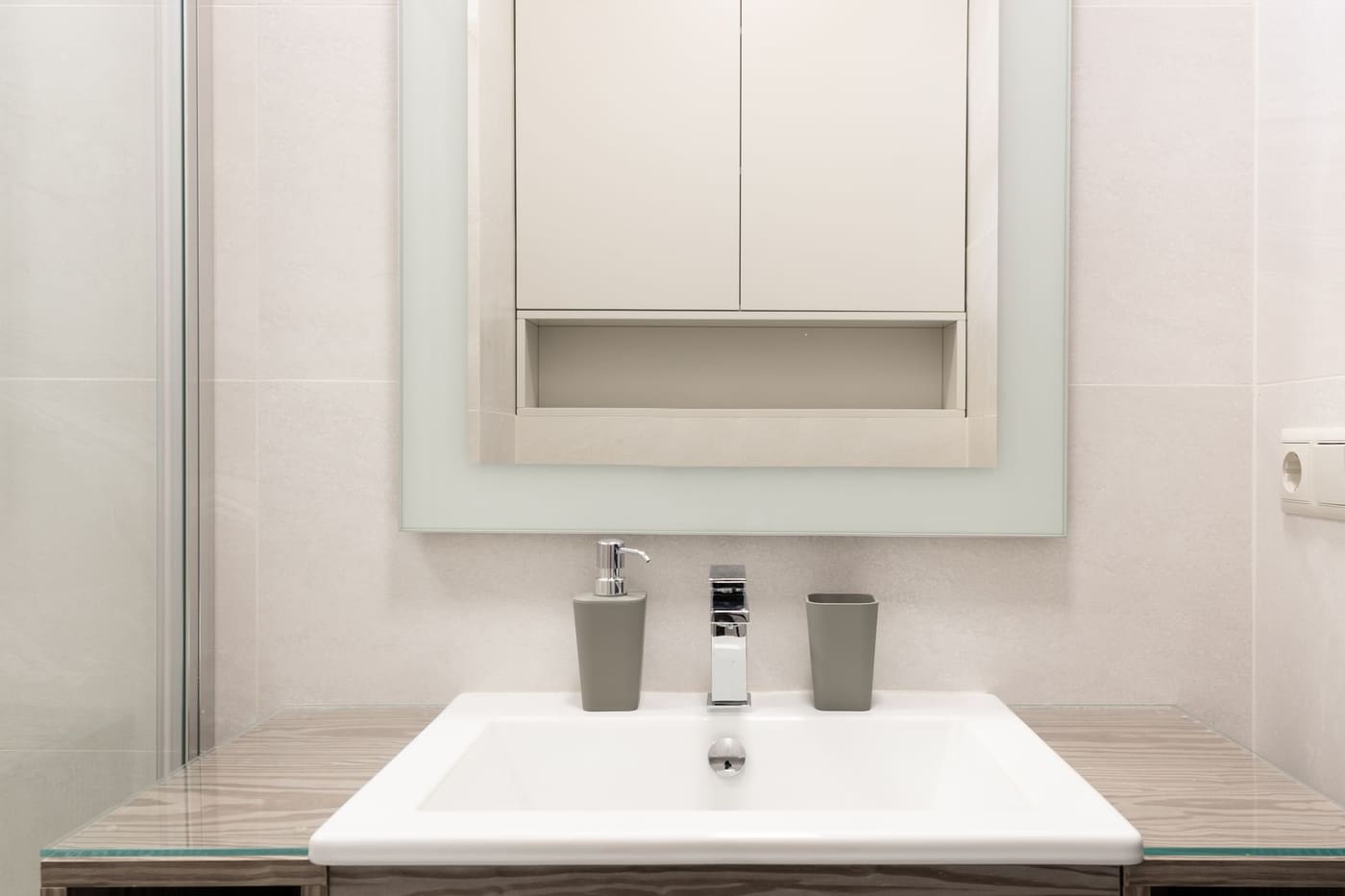
If you swap in a cabinet, what to keep on a bathroom counter helps you decide what goes inside and what leaves the room.
Defogging options
A mirror that stays fogged after a shower is a ventilation problem first and a mirror problem second.
| Option | Typical cost | What it does | Caution |
|---|---|---|---|
| Run the fan during the shower and for about 20 minutes after, a common guideline | Free | Pulls moisture out before it settles | A weak fan needs cleaning or repair |
| Squeegee the glass and wall after showers | Often $5 to $15 | Removes water and speeds clearing | Keep it out of sight if you want a tidy look |
| Anti-fog treatment made for mirrors | Often $5 to $15 | Reduces fogging for a time | Follow the label, and wipe off residue |
| Mirror with a built-in heated pad | Often $100 and up | Keeps part of the glass clear | Hardwired types need a licensed electrician; plug-in types need a ground-fault-protected outlet |
| Open the door or a window | Free | Lets moist air escape | Not an option in every room |
If the mirror fogs for a long time, see how to reduce bathroom moisture when ventilation is not great.
Check what the mirror reflects
Stand at the sink and look at what appears behind you. Many mirrors reflect the toilet, an open door, a hamper or the shower curtain.
- Close the toilet lid and keep the brush hidden behind the toilet.
- Hang a bath towel neatly on a hook in the reflected area, or clear the hook.
- Keep the hamper out of the reflection, or choose one with a lid.
- Keep the shower curtain closed when not in use so it presents a clean surface.
A mirror also bounces light. Facing a window or a light-colored wall, it brightens the room. Facing a dark corner, it adds little, so hang it on the wall that adds the most light if the layout allows.
Mirror add-ons without wiring
When wiring changes are not an option, a few additions improve how the mirror works:
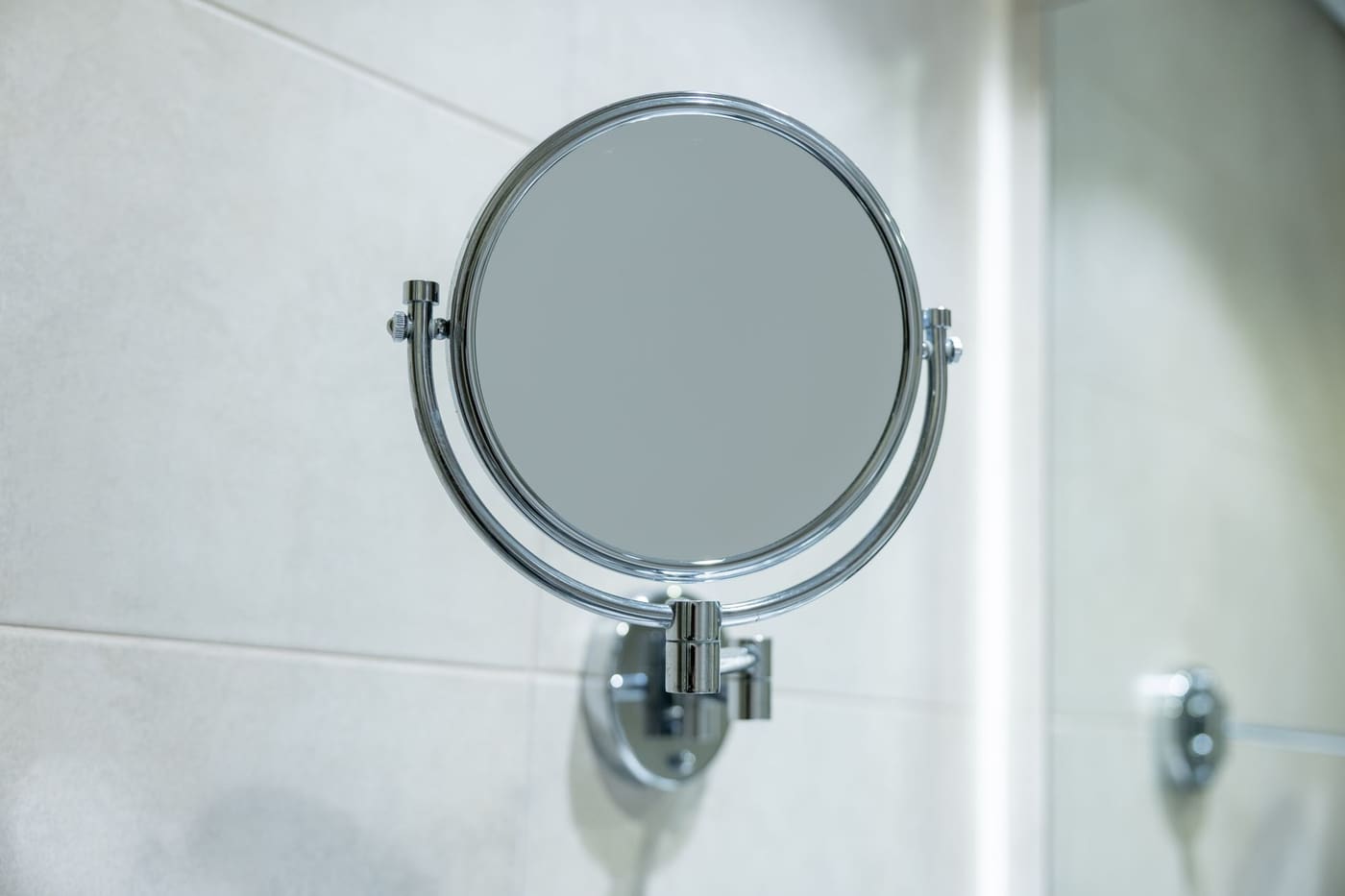
| Add-on | Typical cost | What it does |
|---|---|---|
| Swing-arm magnifying mirror | Often $20 to $60 | Close-up detail without standing nose to glass |
| Lit makeup mirror, plug-in or rechargeable | Often $20 to $80 | Even light on the face for close tasks |
| Battery sconces on adhesive mounts | Often $20 to $60 | Side light without cords |
Anything near the sink should be rated for damp spaces (a hardwired light near a tub or shower may need a wet rating), plug-in cords should stay short, and outlets should have ground-fault protection. If the light itself is the problem, the guide to fixing harsh bathroom lighting without rewiring covers it.
Keep the glass looking good
A clean mirror makes the whole zone feel brighter. Wipe it with a microfiber cloth and a glass cleaner or equal parts water and white vinegar. Spray the cloth, not the mirror, so liquid does not run behind the glass edge. Never mix bleach with ammonia or with vinegar or other acids, and ventilate and wear gloves while you clean.
If the edge shows black or brown spotting, that is often damage to the silver backing from moisture. It cannot be cleaned away, and the fix is usually replacement.
If you rent
If you cannot replace the mirror, a lit makeup mirror and a frame kit, with the landlord’s permission, are the low-risk options. The whole refresh sequence is in updating a bathroom without a full renovation.
Where this comes from
This article is mostly design and installation common sense: sizing and hanging rules of thumb from published bathroom design guidance, the Home Ventilating Institute guidance on running fans after showers, and the US CDC’s warnings about mixing bleach with ammonia or acids. Prices are typical US ranges that vary by store and region.